


SA’s REIPPPP is one of the most successful PPP programmes in emerging markets. It catalysed billions in investment, established a credible procurement framework and launched renewables into the national generation mix. But the landscape has evolved, and so must REIPPPP’s continued relevance.
By Robert Futter, Advisory Partner at Cresco; Olga Suchkova, Associate Director at Cresco; Alexandra Felekis, Partner at Bowmans
The early bid windows (BW1 to BW4) can be considered an unequivocal success. At a time when South Africa faced acute capacity shortages, policy uncertainty and limited private sector participation in generation, the Renewable Energy Independent Power Producer Procurement Programme (REIPPPP) provided a bankable, transparent and competitive capacity procurement mechanism.
While the tariffs in the initial rounds were relatively high, this reflected global technology costs at the time as well as a risk premium associated with a first-of-its-kind programme. Crucially, these rounds achieved their primary objective: they unlocked private investment, established a local renewable energy industry and diversified the generation mix.

Moreover, the programme created institutional credibility. Standardised documentation, government-backed support mechanisms and a disciplined procurement process built investor confidence and enabled South Africa to emerge as a leading destination for renewable energy investment. In this context, higher early-stage costs were justified by the long-term structural benefits delivered to the sector.
“The early rounds were expensive per unit, but small in volume. They created a market for renewables and that in itself is far more valuable than the legacy costs they created,” says Olga Suchkova, associate director at Cresco.
However, from Bid Window 5 onward, the trajectory of the programme becomes more complex. While procurement continued, its alignment with national grid realities and broader energy sector reform objectives has increasingly come into question.
The market context in which REIPPPP operates has fundamentally shifted: private procurement has accelerated, regulatory reforms have enabled bilateral trading and the system is now constrained less by generation capacity than by transmission infrastructure. REIPPPP could still attract bids, but it could not reliably convert them into buildable, grid-connected capacity in the right places. It showed that without transmission expansion, faster permitting and more flexible market structures, auctions can become a queue for scarce grid access rather than a true capacity-allocation mechanism.
Against this backdrop, the continued reliance on a centralised, government-backed procurement model for standard renewable energy technologies appears increasingly misaligned. Over the last couple of years wind and solar PV have become commercially viable and actively pursued by private buyers without the need for sovereign support. In effect, government intervention in this segment began to crowd into a space that the market was already capable of serving efficiently.
At the same time, the programme did not sufficiently adapt its design to reflect emerging system constraints. Grid capacity – particularly in high-resource areas – has become the binding constraint on new generation. Yet auction design continued to prioritise energy price competition without adequately incorporating locational signals, grid availability or system value. The result has been procurement outcomes that are, at best, difficult to implement and, at worst, disconnected from the physical realities of the network.
This raises a more fundamental question: what should be the role of government-backed procurement in a maturing and increasingly liberalised electricity market?
In principle, state support should be directed toward areas where market failures persist or where system needs are not adequately met by private incentives alone. In South Africa’s case, this no longer applies to utility-scale wind and solar generation in isolation. Instead, the most pressing needs relate to transmission expansion, generation flexibility and overall system resilience as the share of variable renewable energy increases.
“The role of the State in mature, liberalised markets should be to create an enabling environment which adapts to the market developments. Only in instances where there is market failure is there a need for the State to step in as the supplier of last resort – this is aligned with amended Section 34 in the Electricity Regulation Amendment Act,” adds Alexandra Felekis, partner at Bowmans.
Future iterations of REIPPPP (or any successor mechanism) should therefore pivot accordingly. Rather than continuing to procure energy on a technology-specific basis with full revenue certainty, the programme should focus on enabling investments that address system constraints and enhance market functionality.
This shift is particularly important in light of the anticipated implementation of the South African Wholesale Electricity Market (SAWEM). SAWEM aims to introduce competition, price discovery and more dynamic system operation. However, the current REIPPPP structure, characterised by long-term, fully-hedged contracts underpinned by government guarantees, effectively insulates participants from market signals.
This creates a structural tension: on the one hand, policy seeks to promote competition; on the other, procurement design continues to remove exposure to price risk and operational incentives.
To align with SAWEM, procurement frameworks must evolve to encourage market participation rather than bypass it. This could include mechanisms that introduce partial merchant exposure, incentivise dispatchability and flexibility, or reward locational value. Without such changes, there is a risk that legacy procurement models will undermine the effectiveness of the market reform.
“REIPPP generators are fully hedged through transition. Everyone else pays for the spread between their contracted rate and the market price,” says Robert Futter, advisory partner at Cresco.
The argument against further REIPPPP rounds is not an argument against all government-backed procurement of capacity. There remain categories where the private sector will not step forward without a government-supported framework, and where the public benefit justifies the structure.
Gas peaker procurement is the clearest example. The private sector will not finance long-term peaker capacity against the merchant risk of an illiquid spot market. A REIPPPP-style structure – competitive, transparent, time-limited – is the appropriate vehicle. The same logic applies to the procurement of the ancillary services, which is rapidly gaining relevance and urgency.
Looking ahead, several priority areas emerge for the evolution of REIPPPP (or any successor mechanism):
Procurement should become more targeted, focusing on transmission-constrained areas and integrating grid expansion planning. This may involve co-optimising generation and network investments or introducing location-specific bidding frameworks.
Greater emphasis should be placed on flexibility and system services. This includes battery energy storage, hybrid projects, and technologies capable of providing ancillary services such as frequency response and reserve capacity.
“In the future public procurement should focus on capacity, ancillary services and technologies which support stabilisation of the grid such as the Independent Transmission Projects (ITP) Programme and the Gas IPP Programme,” attests Felekis.
Contract structures should be redesigned to introduce appropriate levels of market exposure. This would support the development of SAWEM by encouraging generators to respond to price signals and participate actively in balancing and ancillary services markets.
Government support should be used strategically to unlock investments that would not otherwise occur – particularly in grid infrastructure and system balancing – rather than continuing to subsidise mature and commercially viable generation technologies.
REIPPPP has played a foundational role in South Africa’s energy transition. Its early success is undeniable. However, the conditions that justified its original design no longer fully apply. The next phase of reform requires a more nuanced and targeted approach, one that recognises the realities of grid constraints, leverages private sector capabilities, and aligns procurement with the objectives of a competitive and resilient electricity market.
THE FIRST STAGE OF THE ITP PROCUREMENT PROGRAMME
15 December 2025
The Minister of Electricity and Energy, Dr Kgosientsho Ramokgopa, released the outcomes of (i) the conclusion of value for money negotiations under the seventh Bid Window of the Renewable Energy Independent Power Producer Procurement Programme (REIPPPP Bid Window 7) and ii) the recent evaluation conducted under the First Bid Submission Stage of the Independent Transmission Projects (ITP) Procurement Programme. Minister Ramokgopa provided an update on the status of new generation capacity brought on-line during the financial year.
STATUS UPDATE
Minister Ramokgopa also congratulated eight IPP Projects that achieved Commercial Operation Date (COD) to date in 2025/26 financial year and are now delivering electricity to the national grid. These projects were procured under the Bid Window 5 of REIPPPP as well as the Risk Mitigation IPP Procurement Programme. The projects that achieved Commercial Operation Date (COD) in FY2025/26, totalling 800MW, include:
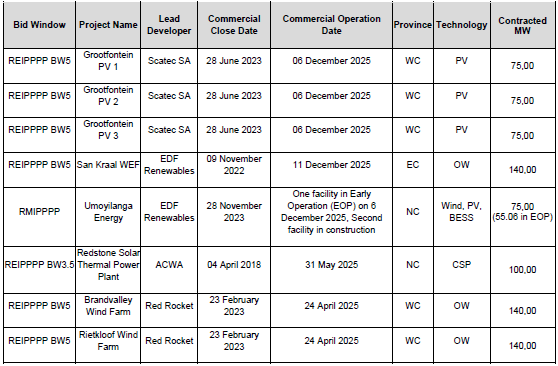
An additional total of 1 610MW from 15 projects is in construction and expected to come on-line during 2026 and 2027.
Since the inception of the Independent Power Producer Procurement Programme (IPPPP) 15 years ago in 2010, a total of 8 161MW of contracted capacity from 103 private sector projects have reached commercial operation. On average, these completed projects took around 28 months to complete, which demonstrates the commitment from all parties in the public-private partnership to ensure that electricity was brought online quickly and affordably.
REIPPPP BID WINDOW 7
The Seventh Bid Window of the REIPPPP (REIPPPP BW 7) was designed to facilitate the procurement of up to 5 000MW on renewable energy capacity, comprising 1 800MW solar PV and 3 200MW onshore wind capacity. Eight solar PV compliant bids, with a combined capacity of 1 760MW were announced by the Minister on 23 December 2024 and appointed as Preferred Bidders.
Following technology reallocation from onshore wind to solar PV as provided for in the Request for Proposal (RFP), the Department announced on 21 July 2025 the appointment of an additional six Preferred Bidders under this Bid Window to provide 1 290MW of solar PV new generation capacity.
At the time, the Department also announced that it would enter into Value For Money (VfM) negotiations with a further eight compliant bidders that were eligible for appointment as Preferred Bidders, subject to positive VfM outcomes. These included four solar PV and four onshore wind eligible bidders. Minister Ramokgopa announced that the evaluation of the VfM proposals from the eligible bidders were completed by the Independent Bid Evaluation Committee, and that the following four (4) Preferred Bidders were appointed to provide a total of 890MW of solar PV capacity, based on their evaluated Value for Money Proposals:
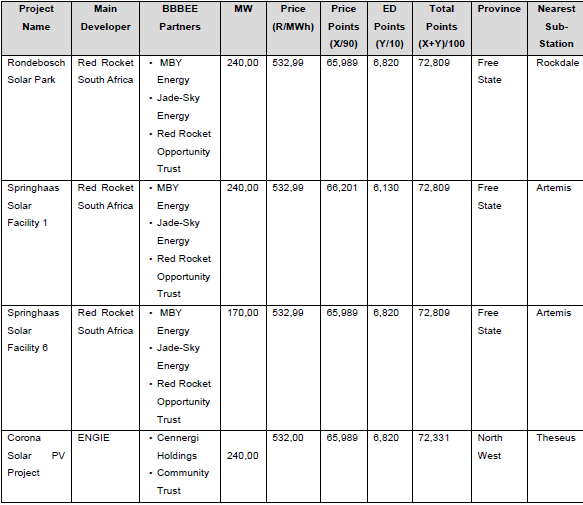
With this announcement, the total capacity procured under the REIPPPP Bid Window 7 now amounts to 3 940MW. The capacity will be built by 18 solar PV IPP projects, spread across the Limpopo, Free State, North-West and Mpumalanga provinces.
The total investment from the additional four solar PV Preferred Bidders announced is R16-billion. South African equity participation of 49% across all the Preferred Bidders and average Black Economic Empowerment participation of 40% have been committed by these projects. These commitments will be translated into contractual obligations under an implementation agreement signed by the Department and the four projects. From an economic development perspective, these projects have committed to:
Create a total of 4134 job opportunities for South African citizens (measured in job years) during both the construction and operational phases of the contracts.
Allocate 41% of Total Project Costs to Local Content, equating to R4.4-billion during construction and R2-billion during the operation and maintenance phases.
Invest a further R163-million in economic development initiatives, including supplier development, skills development, bursaries for black students, skills development initiatives for disabled persons and socio-economic development initiatives in communities during construction and over the 20-year lifetime of the projects.
ITP PROCUREMENT APPOINTMENT OF PRE-QUALIFIED BIDDERS
Seven pre-qualified bidders were appointed under the Request for Pre-Qualification (RFQ) stage of Phase I of the ITP Programme. This stage of the ITP Procurement Programme marks a defining milestone in government’s strategic drive to expand, modernise and strengthen South Africa’s transmission network through diversified delivery mechanisms and sustained private sector participation, in support of long-term economic growth, industrial development and national energy security.
The RFQ was launched on 31 July 2025, with responses submitted on the response submission date of 23 September 2025. The evaluation process, conducted by an Independent Bid Evaluation Committee under strict security measures, took place at the IPP Office.
The independent evaluation was conducted against clearly-defined legal, technical and financial pre-qualification criteria as set out in the RFQ. On the response submission date, the Department received a total of 17 pre-qualification responses. Following the independent evaluation process, the following seven pre-qualified bidders were appointed:

Since the ITP Procurement Programme is the first of its kind in South Africa, the Department adopted a structured, transparent and market-building procurement approach to test market depth, refine bankability parameters and ensure investor readiness through a sequenced process comprising:
a) Request for Information (RFI), which was released on 15 December 2024 and closed on 28 February 2025.
b) Request for Pre-Qualification (RFQ) that was released on 31 July 2025.
c) Draft Request for Proposals (Draft RFP) to be released to pre-qualified bidders on receipt of the signed acceptance of their pre-qualified bidder appointment letters.
d) Final RFP, which is anticipated to be released by Quarter 3 of the 2026/27 calendar year.
This structured market consultation, unprecedented in South Africa’s transmission procurement, ensures that the final RFP will:
- Be a fit-for-purpose RFP that reflects market realities, lender expectations and international best practice.
- Enable early identification of technical and commercial barriers, thereby minimising post-release clarifications.
- Enhance investor confidence, signalling government’s commitment to transparency, predictability and collaboration.
- Provide a strong foundation for competitive, high-quality bids that support timely financial close.
- Reduce downstream clarifications once the RFP is formally released.
- Reinforce South Africa’s reputation for transparent, credible and world-class energy procurement.
ENERGY INFRASTRUCTURE PROGRAMME
Localisation and industrialisation remain central pillars of South Africa’s economic strategy and are critical to rebuilding productive capacity, creating sustainable employment and strengthening economic resilience. As the country undertakes one of the largest transmission infrastructure build programmes in its history, government is leveraging this investment to stimulate domestic manufacturing, deepen local value chains and position the South African industry at the centre of the energy transition.
Through the Independent Transmission Projects (ITP) Programme, large-scale infrastructure investment is being aligned with clear industrial policy objectives to ensure that growth in the electricity sector translates into tangible economic and developmental outcomes.
By prioritising local production, skills development, enterprise participation and technology transfer, the programme seeks to crowd in private investment while simultaneously supporting local industry, expanding industrial capability, and securing long-term economic value for the country.

The Minister outlined the economic development framework embedded in the Draft Request for Proposals (RFP), which positions the ITP Programme as a key lever for economic growth, industrial development and job creation. Bidders will be required to support South Africa’s localisation and industrialisation agenda through the inclusion of minimum amounts of local production and local content, as prescribed by the Department of Trade, Industry and Competition (the dtic), in their bid submissions.
The ITP Programme is structured to leverage industries, sectors and sub-sectors designated by the dtic for local production at prescribed local content levels. This approach is intended to deepen domestic manufacturing capability, strengthen local supply chains, support skills development and maximise the broader economic and developmental impact of sustained investment in transmission infrastructure.
A wide range of industries and value-chain segments are expected to benefit from the ITP Programme’s localisation and industrialisation drive, including, among others, steel products and components for construction; transformers, shunt reactors and associated equipment; electrical cable products; powerline products and other designated items as determined by the dtic.
The National Industrial Participation Programme (NIPP), which has been in effect since September 1996 and applies to all government procurement contracts with imported content of US$10-million or more, will be applicable to the ITP Programme. NIPP obligations apply to those products, sectors or sub-sectors forming part of a bidder’s project that are not designated for local content, or where local content requirements are not applicable.
Where a project includes imported content of US$10-million or more, bidders will be required to undertake a NIPP obligation equivalent to 30% of the value of the imported content. This obligation will be discharged over a seven-year period through qualifying activities aligned to the bidder’s economic development commitments, including capital investment, outsourcing to SMMEs and BEE-owned SMMEs, skills development and training, technology transfer, research and development, export promotion, licensed production and subcontracting.
The ITP Programme remains on track to unlock large-scale investment in transmission infrastructure and is being implemented in a manner that upholds bankability, transparency and credibility, which are key conditions for long-term investor confidence.